What is sudden cardiac death?
Sudden cardiac death (SCD) is an unexpected death caused by a problem with the heart, usually resulting in a dangerous abnormal heart rhythm and cardiac arrest. It can occur in apparently healthy young people, sometimes during exercise, but also at rest or during sleep.
When a post-mortem examination cannot identify a structural cause for the death, the term sudden arrhythmic death syndrome (SADS) may be used. This can occur when the underlying problem affects the heart’s electrical system rather than its structure.
How common is it?
Sudden cardiac death in young people is rare, but its impact on families and communities can be devastating. Exact figures vary according to the age group studied and how deaths are recorded.
Sudden arrhythmic death syndrome alone is estimated to account for around 500 deaths in England and Wales each year. Sudden cardiac death from all causes is a broader category.
What can cause sudden cardiac death in a young person?
Several heart conditions can increase the risk, including:
- Inherited heart muscle conditions, such as hypertrophic cardiomyopathy, in which the heart muscle becomes abnormally thickened.
- Inherited electrical conditions, such as long QT syndrome, Brugada syndrome and catecholaminergic polymorphic ventricular tachycardia (CPVT). These can cause dangerous heart rhythms even when the heart looks structurally normal.
- Other heart muscle conditions, including arrhythmogenic cardiomyopathy, which can affect the heart’s electrical stability.
Some conditions are inherited and may affect several members of the same family. Others may occur without any previously recognised family history.
Who is most at risk?
The risk is higher in people who have:
- A close relative who died suddenly and unexpectedly at a young age, particularly before the age of 40, or a family history of an inherited heart condition.
- Unexplained fainting, particularly during exercise or in response to sudden exertion.
- Chest pain, palpitations or unexplained breathlessness during exercise.
- A previously identified heart murmur, abnormal ECG or known heart condition.
Competitive sport does not necessarily cause these conditions, but intense exercise may trigger a dangerous heart rhythm in someone with an underlying condition.
Importantly, some affected people have no symptoms and no known family history before their first serious event.
Can screening identify people at risk?
Screening aims to identify an underlying heart condition before symptoms develop. Assessment may include a medical and family history, physical examination and an electrocardiogram (ECG). If indicated, further tests may include an echocardiogram (an ultrasound scan of the heart), exercise testing or specialist investigations.
An ECG records the heart’s electrical activity and can identify some important abnormalities, including certain inherited electrical conditions. However, it cannot detect every condition that may cause sudden cardiac death. Some people with a genuine underlying condition have a normal resting ECG.
Similarly, a normal examination does not exclude all important heart conditions. Screening can therefore reduce uncertainty but cannot guarantee that an individual is free from risk.
Should all young people have a routine ECG?
This is an important and often debated question. In the UK, the National Screening Committee does not currently recommend universal population screening for sudden cardiac death in people under the age of 39, although a further review is expected in 2026–27.
The reason is not that ECGs are unhelpful. Rather, the evidence has not established that screening every apparently healthy young person reliably prevents enough deaths to outweigh the potential harms. These include missed conditions, false-positive results, unnecessary investigations, anxiety and possible restrictions on sporting activity.
A large study published in 2026 analysed more than 100,000 young people who underwent cardiac screening through the Cardiac Risk in the Young (CRY) programme over a 10-year period. Screening, which included a cardiac history and ECG, identified conditions associated with sudden cardiac arrest or sudden cardiac death in approximately 0.3% of those screened. Of those identified, 41% subsequently received significant risk-reducing interventions. The study reported ECG sensitivity of approximately 75% for conditions associated with sudden cardiac arrest or death.
This new evidence may therefore contribute to the National Screening Committee’s next review of its recommendations.
What is the most practical approach?
A pragmatic approach is to identify young people who may be at increased risk and ensure that they receive appropriate assessment.
This includes:
- Taking a careful personal and family history, including unexplained fainting, symptoms during exercise, premature sudden deaths and known inherited heart conditions.
- Performing a clinical examination and ECG. ECGs in adolescents can be more complex to interpret than those in adults, so specialist interpretation by a paediatric or sports cardiologist is important.
- Arranging referral to a paediatric cardiologist when concerns arise.
Cardiac Risk in the Young (CRY) reports that approximately 4–5% of people undergoing its cardiac screening programme require further investigation following an initial health questionnaire and ECG. This does not mean that 4–5% are diagnosed with significant heart disease; for many, further investigations will ultimately be reassuring.
Further assessment by a paediatric cardiologist may include a repeat ECG, echocardiogram (cardiac ultrasound), 24-hour ECG monitoring and an exercise stress test.
If there is a cardiac concern, a young person may be advised to pause high-intensity sport while further investigations are carried out.
What should I do if I am concerned about my teenager?
Sloane Street Surgery in London and Marlborough is introducing a new Adolescent Health Check, designed for teenagers aged 13 and over and providing a broader assessment of their health and wellbeing.
The health check includes:
- A personal health review covering medical and family history, medication, sleep, nutrition, emotional wellbeing and vaccination status, tailored to your teenager’s needs.
- A baseline physical examination, including height, weight, pulse, blood pressure and examination of the heart.
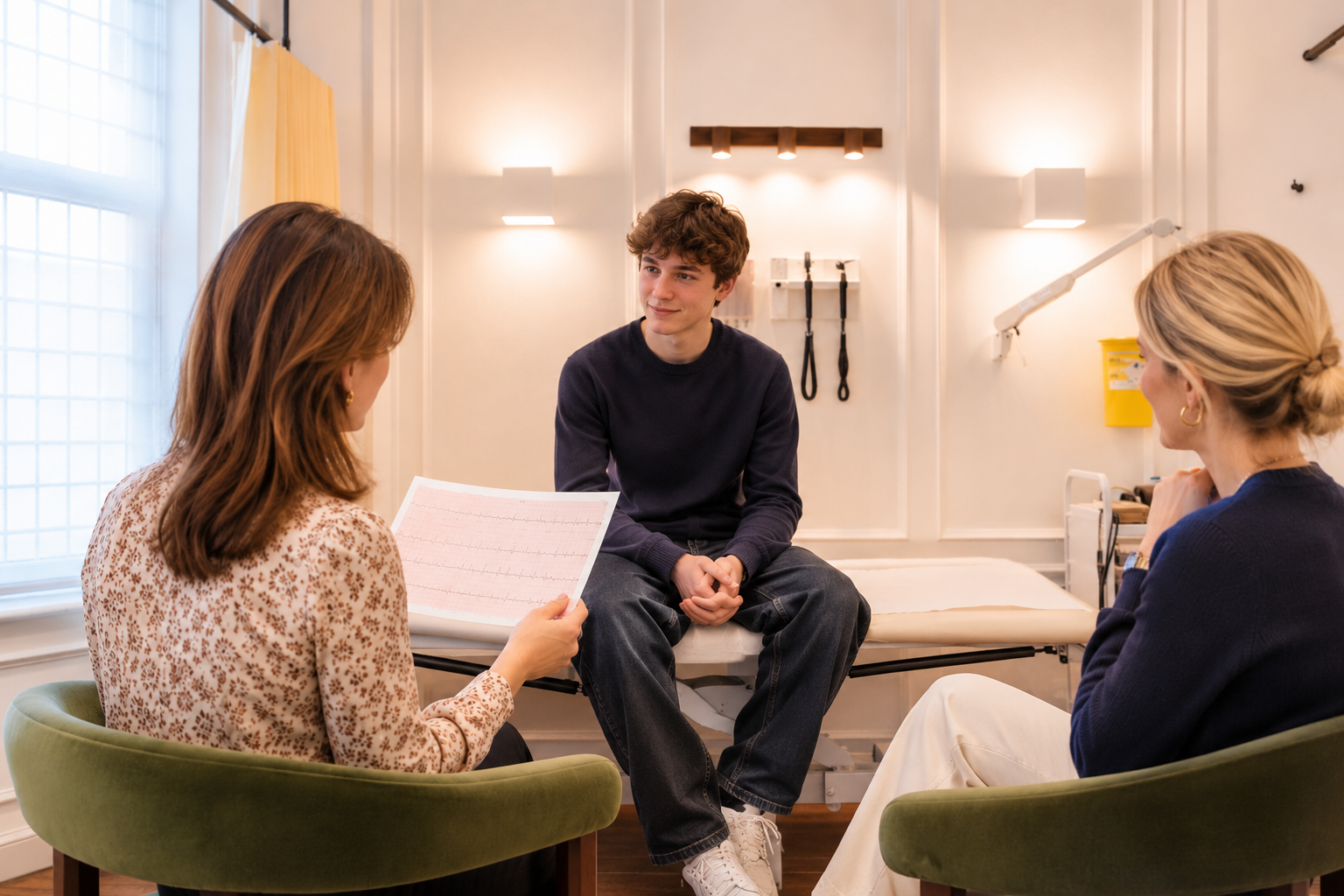
- A heart assessment covering exercise-related symptoms and family history, together with a resting 12-lead ECG, a quick and painless recording of the heart’s electrical activity. Specialist interpretation by a paediatric or sports cardiologist can then be arranged.
- A discussion about sporting injuries, concussion and head injury, including recognising symptoms, reporting them promptly and returning safely to learning and sport.
If you would like to arrange an Adolescent Health Check for your teenager, or would like to discuss whether an assessment may be appropriate, please speak to the Sloane Street Surgery team.
The Adolescent Health Check is charged at the standard rate for a 30-minute GP consultation and includes the ECG. Specialist ECG interpretation by a paediatric or sports cardiologist is an additional £50.
References
Nunn LM, Lambiase PD. Genetics and cardiovascular disease—causes and prevention of unexpected sudden adult death: the role of the SADS clinic. Heart. 2011;97(14):1122–1127.
MacLachlan H, et al. Cardiac Screening for Conditions Associated with Sudden Cardiac Death. Journal of the American College of Cardiology. 2026;87(7).
UK National Screening Committee. Sudden cardiac death: UK NSC screening recommendation.
Cardiac Risk in the Young (CRY). Cardiac screening information.
About the author

MBBS BSc DCH MRCGP DipDerm PGCEd
“I’ve always committed to keeping a holistic, kind and compassionate approach to my care, encompassing patients’ physical, psychological and global wellbeing.”
Achieving a Merit award for MRCGP in 2008 before working in a large, busy NHS practice in Putney for 12 years. I became the in-house opinion in Dermatology after achieving a Merit award for my Diploma in Dermatology. I trained to be a Trainer who teaches other doctors to become GPs and received my PCGEd Merit from London Deanery in 2012.
I have worked at The Royal Mews Surgery, London for the past 6 years and am now Apothecary to the King and Queen’s Royal Household, Buckingham Palace.