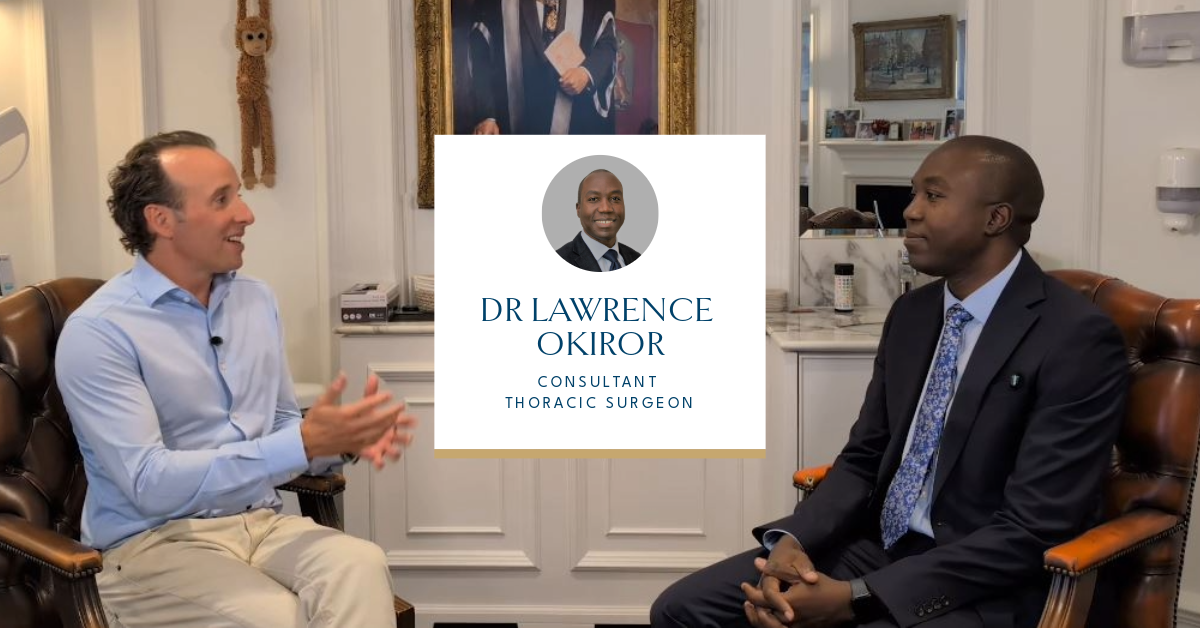
Consultant Thoracic Surgeon Dr Lawrence Okiror joins Dr Patrick Ruane of Sloane Street Surgery for our latest expert Q&A. They discuss advances in lung cancer diagnosis and treatment, including how robotic bronchoscopy is helping doctors investigate small lung nodules earlier and more safely. Dr Okiror also explains the importance of specialist surgical teams and how minimally invasive surgery can help patients living with severe excessive sweating (hyperhidrosis).
Watch the full conversation below, or read our edited Q&A.
00:04 Lung cancer: advances in early diagnosis and treatment
Dr Patrick Ruane: We’ve just had a fascinating discussion about the latest developments in thoracic surgery. Could you explain some of the advances in lung cancer screening and diagnosis, and what they mean for patients?
Dr Lawrence Okiror: One of the most exciting developments has been the introduction of low-dose CT screening for lung cancer.
For many years, we struggled to identify lung cancer early enough to intervene and make a meaningful difference to patients’ lives. With CT screening, we’re now seeing more lung cancers diagnosed at an earlier stage, when treatment is more likely to be successful.
Clinical trials have shown that screening can make a real difference in reducing deaths from lung cancer.
However, this has also presented a new challenge. We’re detecting increasing numbers of small lung nodules, the vast majority of which are benign. The difficulty is knowing which are harmless and which might represent an early cancer.
This is where new diagnostic technologies, particularly robotic bronchoscopy, are making such an important difference.
02:42 What happens when a lung nodule is found?
Dr Patrick Ruane: Patients might have a lung nodule discovered during a scan for something completely unrelated, such as a heart investigation, or perhaps because they’ve had a persistent cough. How would these nodules traditionally have been investigated, and what’s changed?
Dr Lawrence Okiror: Until recently, we had two main options.
The first was to monitor the nodule with repeat CT scans, perhaps after three or six months. If it remained unchanged, that could be reassuring. But if it was something more concerning, we might see it grow.
The difficulty is that a nodule measuring six millimetres could grow to 10 or 12 millimetres during that time. If it is lung cancer, we know that the earlier we identify it, the better the potential outcome.
The second option was a CT-guided biopsy, where a needle is passed through the chest wall into the lung to obtain a tissue sample. This was generally more suitable for larger nodules, particularly those near the edge of the lung.
Both approaches have limitations, which is why the arrival of robotic bronchoscopy has been such an important advance.
02:07 What is robotic bronchoscopy, and how does it improve diagnosis?
Dr Patrick Ruane: You mentioned robotic bronchoscopy as one of the most exciting developments. How does it work, and what advantages does it offer compared with the techniques previously available?
Dr Lawrence Okiror: Robotic bronchoscopy is a relatively new technique that allows us to reach and biopsy very small nodules, including those located deep within the lung or towards its outer edges.
It uses a very small, highly manoeuvrable instrument that passes through the windpipe and into the airways.
Previously, some of these nodules were simply too small or difficult to reach safely. We would have had to wait and monitor them with further scans.
Now, we’re able to reach much smaller nodules and obtain tissue samples at an earlier stage.
There are also important advantages in terms of diagnostic accuracy, safety and speed.
With a traditional CT-guided biopsy, a needle passes through the chest wall into the lung. One of the most common complications is a pneumothorax, or collapsed lung, which can be painful and sometimes requires several days in hospital.
Robotic bronchoscopy reaches the nodule through the airways instead, avoiding the need to pass a needle through the chest wall.
We now have comparative data showing significantly lower rates of pneumothorax with robotic bronchoscopy. In the figures I discussed, the rate was approximately 30% with CT-guided biopsy, compared with around 1.8–1.9% with robotic bronchoscopy.
We’re also seeing improved diagnostic accuracy for the small nodules we’re investigating.
Another important benefit is speed. We can often obtain a preliminary assessment of the tissue sample on the same day, although final laboratory results take longer.
For patients, this can mean a faster diagnosis, fewer complications and less time spent waiting for answers.
05:45 Why is the experience of the wider surgical team so important?
Dr Patrick Ruane: You also mentioned the extraordinary number of procedures performed at Guy’s and St Thomas’. How does working in such an experienced centre benefit patients?
Dr Lawrence Okiror: At Guy’s and St Thomas’, we’re fortunate to work within the largest thoracic surgery unit in the country, treating a very high volume of patients.
That experience is incredibly valuable, but good outcomes aren’t just about the surgeon. They’re about the whole team.
We work closely with experienced anaesthetists, respiratory physicians, physicians specialising in the care of older patients and physiotherapists.
Together, we can prepare patients for surgery, manage other medical conditions and support their recovery afterwards.
For example, we might see a patient with lung cancer who has previously suffered a heart attack or has other significant health problems.
In the past, we may have considered surgery too high-risk. Now, by working together to optimise their health beforehand, we can sometimes offer potentially life-saving surgery to patients who might previously have been unable to undergo an operation.
Our data has shown that even two weeks spent improving the management of existing medical conditions before surgery can improve outcomes and reduce the length of time patients need to remain in hospital.
Physiotherapy also plays an important role in getting patients moving again after surgery, helping them recover and reducing the risk of complications.
It’s the combined experience of the entire team that allows us to offer treatment to more patients.
07:45 Hyperhidrosis: how can surgery help with excessive sweating?
Dr Patrick Ruane: Moving on to another condition you treat, hyperhidrosis – or excessive sweating – may not have the same medical implications as lung cancer, but it can be incredibly debilitating. Could you explain what causes it and how thoracic surgery can help?
Dr Lawrence Okiror: Hyperhidrosis is a condition associated with overactivity of the sympathetic nervous system, which controls sweating in different parts of the body, particularly the hands and armpits.
Although it may not sound as serious as some of the other conditions we treat, the impact on someone’s quality of life can be enormous.
Patients with severe sweating of the hands may struggle with everyday activities such as writing or holding paper.
It can also be socially embarrassing and isolating, and some people find it extremely difficult to live with.
There are several treatments available, including medication to reduce sweating and Botox injections, particularly for the armpits.
However, these treatments don’t work for everyone, and some patients continue to experience significant symptoms.
For those patients, surgery may offer another option.
It might sound surprising, but the nerves that control sweating in the hands run through the chest.
By identifying and dividing the specific nerves responsible for excessive sweating, we can significantly reduce the symptoms.
09:45 How successful is surgery for hyperhidrosis, and what does recovery involve?
Dr Patrick Ruane: It sounds as though this can be a life-changing procedure for patients. How successful is the surgery, and what can someone expect in terms of recovery?
Dr Lawrence Okiror: In appropriately selected patients, the results can be very good. More than nine in ten patients undergoing surgery for excessive sweating of the hands experience a significant improvement.
One possible side effect is compensatory sweating, where patients notice increased sweating elsewhere on the body, particularly the back or abdomen.
This is something we discuss carefully with patients before surgery. In my experience, many have found this more tolerable than the severe sweating they previously experienced in their hands, although it can be troublesome for some people.
The operation is performed under general anaesthetic using minimally invasive keyhole surgery, usually as a day-case procedure or with one night in hospital.
Recovery is generally quite quick, with many patients able to return to work within approximately a week.
For someone who has struggled with severe hyperhidrosis for years, the improvement can be life-changing.
When should I seek specialist advice?
If you have concerns about a lung nodule, persistent respiratory symptoms or excessive sweating, our GPs can assess your symptoms and advise on the most appropriate next steps.
At Sloane Street Surgery, we work closely with a trusted network of consultants and specialists, including Dr Okiror, and can arrange further investigations or specialist referral where appropriate.
Appointments can be booked online or by calling the surgery on 020 7245 9333.
About the guest
Dr Lawrence Okiror
Consultant Thoracic Surgeon
Dr Lawrence Okiror is a Consultant Thoracic Surgeon practising at The Lister Hospital in Chelsea and London Bridge Hospital.
He specialises in minimally invasive and robotic thoracic surgery, particularly the diagnosis and treatment of lung cancer, lung nodules and advanced emphysema. He also treats conditions including hyperhidrosis (excessive sweating).
Dr Okiror has performed more than 1,000 lung cancer operations as a consultant, with over 80% carried out using robotic or minimally invasive techniques. He is part of the thoracic surgery team at Guy’s and St Thomas’ NHS Foundation Trust, where he also provides a specialist service for patients with advanced emphysema and COPD.
He is a Fellow of the Royal Colleges of Surgeons of England and Edinburgh in Cardiothoracic Surgery and is actively involved in surgical education and the development of robotic surgery.
For more information, visit www.lungsurgeon.co.uk.
About the author
BSc (Hons) MBChB (Hons) MRCP MRCGP
“Having the opportunity to help people is the privilege of being a GP and makes every day enjoyable. General practice rewards curiosity and empathy with fascinating insights into how disease and life’s journey impacts people in such varied ways. It is often humbling, and always interesting”.
I joined Sloane Street Surgery in 2009 and am delighted to be part of a team committed to striving for excellence in health care. I enjoy all areas of general practice, particularly preventative healthcare, internal medicine, paediatrics, diagnostic challenges and getting to the bottom of mental health problems.