

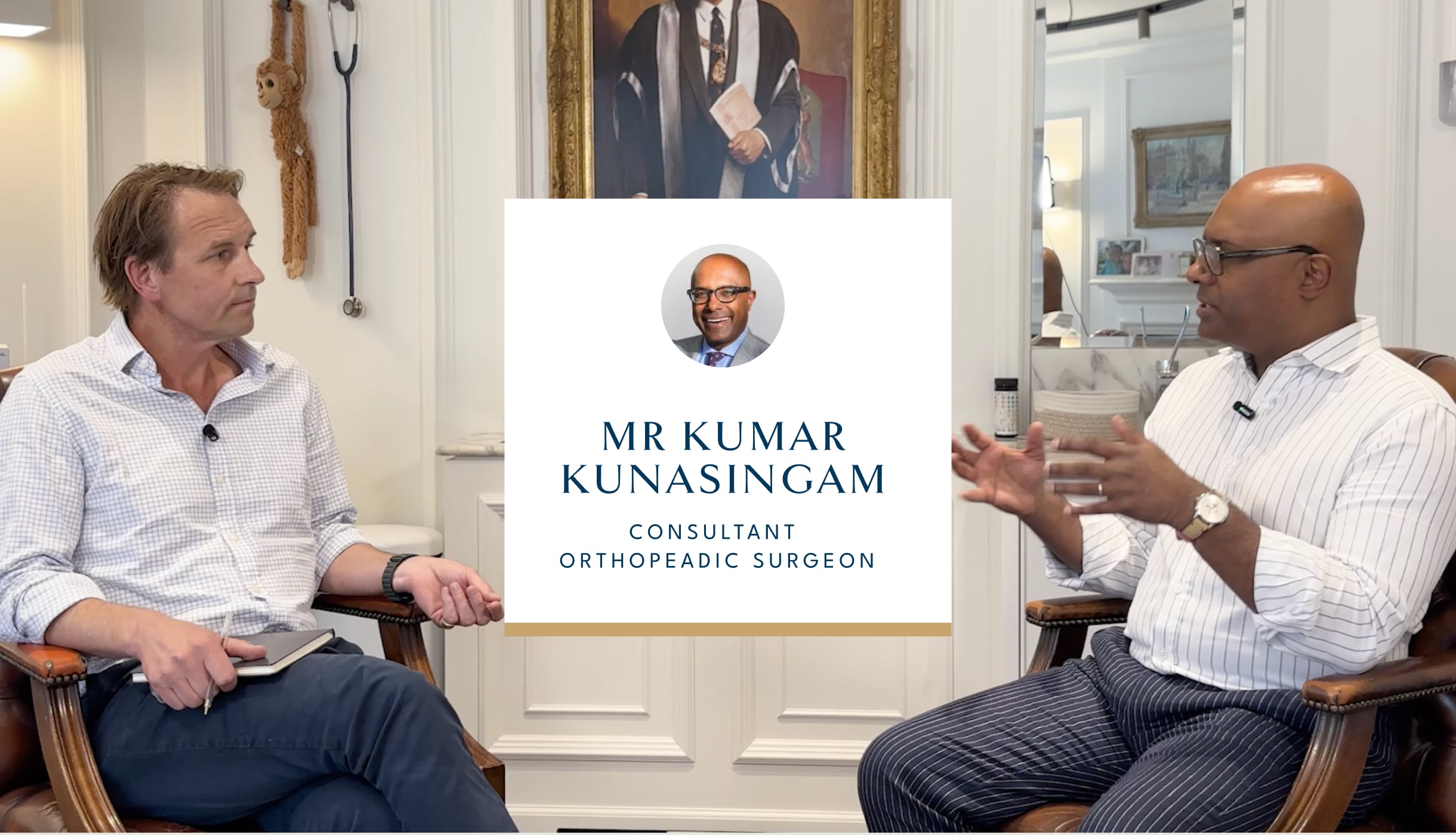
Consultant Orthopaedic Surgeon Mr Kumar Kunasingam joins Dr Toby Dean of Sloane Street Surgery to discuss three common foot and ankle problems: plantar fasciitis, bunions and ankle sprains. He explains what may be causing the pain, what you can do to aid recovery, when further investigation may be helpful and when surgery might be considered.
00:49 – Plantar fasciitis: what causes heel pain and how can it be treated?
Dr Toby Dean: We see a lot of patients with plantar fasciitis – or plantar fasciopathy. What is actually going on?
Mr Kumar Kunasingam: Plantar fasciopathy is a very common cause of heel pain and broadly I see two groups of patients.
The first is the very active or athletic patient who may have taken a misstep or landed awkwardly on their heel, damaging the thick tissue on the bottom of the foot – the plantar fascia – and causing it to become inflamed.
For these patients, rest and icing can be very helpful, alongside physiotherapy. I don’t routinely inject these injuries because injections don’t necessarily make them recover faster and there is a risk of rupture.
Rest before recovery is important. That doesn’t mean you have to stop exercising completely. Upper-body exercise and static cycling, for example, can help maintain fitness without putting too much stress through the plantar fascia. As things improve, strength, conditioning and movement become important parts of recovery.
The other group includes people for whom weight may be contributing to the load through the heel. Again, establishing the correct diagnosis is important. If symptoms aren’t settling, an ultrasound or MRI can sometimes help determine whether we’re dealing with inflammation or an underlying tear.
For most people, treatment involves icing, stretching, weight management where appropriate, regular movement and – perhaps the hardest advice – patience.
Can icing help plantar fasciitis?
Dr Toby Dean: You mentioned using an ice slipper. How does that work?
Mr Kumar Kunasingam: An ice slipper is essentially a reusable cold slipper that can be kept in the fridge or freezer and worn over a pair of socks.
It’s important to protect the skin because direct exposure to something very cold can cause an ice burn. I generally suggest around 10–15 minutes at a time, if comfortable.
There are similar ice wraps for ankle injuries. The advantage is simply that they stay in place and are reusable, so they’re often more practical than trying to balance a bag of frozen peas on your foot.
Do stretching and rolling exercises help plantar fasciitis?
Dr Toby Dean: We used to recommend rolling the foot over a golf ball or frozen bottle. Is that still useful?
Mr Kumar Kunasingam: I think that’s still good advice. You’re stimulating the area while also getting some stretching through the tissues.
If symptoms aren’t improving despite these measures, that’s when further investigation may become helpful. An ultrasound or MRI can identify things such as an underlying tear, bone bruising or, occasionally, an insufficiency fracture.
That’s important because treatment can differ. For example, if there is a fracture, pushing ahead with physiotherapy may actually make things worse and the foot may instead need to be protected in a boot.
How long should you wait before seeing someone about plantar fasciitis?
Dr Toby Dean: If someone thinks they have plantar fasciitis, how long should they leave it before seeking specialist advice?
Mr Kumar Kunasingam: Not everyone needs imaging or a specialist consultation straight away. With appropriate advice, you can often give it a few weeks and see whether things begin to improve.
The important point is whether you’re making progress. If the pain is persistent and isn’t responding to rest, stretching, icing and rehabilitation, that’s the point at which it’s worth considering further assessment and the next steps.
06:18 – Bunions: when should you consider treatment?
Dr Toby Dean: Another problem we see all the time is bunions. Why do people develop them and are they really caused by wearing the wrong shoes?
Mr Kumar Kunasingam: Bunions are largely hereditary. There is often somebody else in the family who has had them.
There has historically been a tendency to blame footwear, particularly narrow or pointed shoes, but bunions existed long before those types of shoes did. Foot structure plays an important part, and although bunions are much more common in women, they can affect men too.
The key question is not simply whether you have a bunion, but whether it is causing pain.
Pain can occur around the big toe joint itself, the second or third toes as the big toe moves across, or even along the outside of the foot as the foot becomes wider and pressure from footwear increases.
The first step is usually to try broader, more comfortable footwear and ask whether the symptoms are manageable.
When should you have bunion surgery?
Dr Toby Dean: When is it time to consider surgery?
Mr Kumar Kunasingam: Pain is the important indication for considering surgery. If a bunion isn’t painful, I wouldn’t recommend operating on it simply because of how it looks.
Surgery should always be the last option.
However, the way we perform bunion surgery has developed considerably. Minimally invasive – or keyhole – bunion surgery allows us to access and realign the bones through very small incisions.
The bones are repositioned into a straighter alignment and held in place with screws. In appropriate patients, this can be performed as day-case surgery and patients can bear weight immediately. I generally aim for patients to progress into stretchy trainers at around two weeks, alongside a structured recovery programme.
Is minimally invasive bunion surgery painful?
Toby: I think some patients are frightened of bunion surgery because they’ve heard the recovery can be very painful. Has that changed?
Mr Kumar Kunasingam: We shouldn’t sugar-coat surgery. Minimally invasive surgery still involves incisions and an osteotomy – cutting and repositioning bone – so there will be a degree of pain and discomfort during recovery.
The difference is in the surgical approach and the recovery journey. With minimally invasive surgery, we’re accessing the bones through small portals rather than making a much larger open incision and disrupting more of the surrounding tissue.
Ultimately, though, surgery isn’t a competition between techniques. The important things are choosing the appropriate treatment for the individual patient, understanding the recovery involved and achieving a good long-term outcome.
And the fundamental message remains: if your bunion isn’t painful, don’t have an operation.
10:56 – Ankle sprains: when is a twisted ankle more serious?
Toby: We’ve probably all twisted an ankle at some point. How do you know when an ankle sprain needs further investigation?
Mr Kumar Kunasingam: Most of us have twisted an ankle and simply carried on. In many cases, the pain and swelling gradually settle.
I’d be more concerned when that isn’t happening – particularly if there is significant swelling or bruising, you can’t comfortably put weight through the ankle, or your symptoms aren’t progressively improving.
Patients sometimes come to see me having already had an X-ray and been told that nothing is broken. But there is much more to the ankle than bone.
We also need to think about the soft tissues, particularly the ligaments on the outside of the ankle and the ligaments connecting the tibia and fibula. Injury to the latter is often described as a high ankle sprain.
If an ankle isn’t improving after a week or two, an examination can help identify exactly where the pain is coming from. An MRI may then be useful because it can show ligament damage as well as bone bruising.
Bone bruising can be very painful and may take a considerable time to settle, but it doesn’t necessarily require surgery. Sometimes having the diagnosis is useful because we understand why the ankle is still painful and can give it the time it needs to recover.
Should you use crutches after an ankle sprain?
Toby: If you’ve badly sprained your ankle and have a lot of swelling and pain, is it reasonable to use crutches and avoid putting weight through it initially?
Mr Kumar Kunasingam: Absolutely. Crutches, a walker boot or an ankle support can sometimes help protect the ankle and control pain in the early stages.
However, these aren’t substitutes for appropriate medical advice. If you’re struggling to bear weight, have substantial swelling or bruising, or the ankle simply isn’t getting better, it should be properly assessed.
Can an old ankle sprain cause long-term ankle instability?
Toby: What about someone whose ankle remains weak months or even years later and repeatedly rolls? Could that go back to an old ankle sprain that never properly recovered?
Mr Kumar Kunasingam: Yes. We sometimes see patients later in life with damage and arthritic changes in the ankle who, looking back, remember repeatedly rolling their ankle while playing sport without having proper rehabilitation.
That won’t happen to everyone, but it illustrates why good physiotherapy, an accurate diagnosis and appropriate rehabilitation after an ankle injury matter.
If somebody continues to have repeated ankle sprains despite a proper course of physiotherapy – including resistance work and balance or wobble-board exercises – we can sometimes consider ligament reconstruction.
This can be performed as day-case surgery, followed by protection of the wound and then mobilisation and physiotherapy.
The objective is not simply to deal with today’s symptoms, but to restore stability and help protect the ankle for the future.
When should I seek advice about foot or ankle pain?
Many common foot and ankle problems improve with time, appropriate rest and rehabilitation. However, persistent pain, significant swelling or bruising, difficulty bearing weight, recurrent ankle instability or symptoms that aren’t improving may warrant further assessment.
At Sloane Street Surgery, our GPs can assess foot and ankle symptoms and, where appropriate, arrange imaging, physiotherapy or referral to a specialist.
Appointments can be booked online here or by calling the surgery on 020 207245 9333
About the guest

Mr Kumar Kunasingam
Consultant Orthopaedic Surgeon
Mr Kumar Kunasingam is a Consultant Orthopaedic Surgeon specialising in foot and ankle surgery. His expertise includes minimally invasive bunion surgery, sports injuries, arthroscopy and foot reconstruction. He takes a holistic approach to treatment, considering not only the condition itself but also each patient’s recovery and overall wellbeing. He trained in London and Sydney, where he developed expertise in minimally invasive techniques and the treatment of elite athletes.
About the author

BA (Hons) MB BSMRCGP
“The most fulfilling part of this job is making a real difference to patients with timely diagnoses and supporting them going through a difficult time”.
I enjoy the full variety of General Practice and recognise the benefits in both continuity and time that private care affords. I have a particular interest in disease prevention, chronic disease management and paediatrics.
The key to our success is maintaining and improving our patients’ health, managing chronic disease meticulously and working alongside the best specialists when needed.